- Principal{s} by ScaleUp
- Posts
- What is the role of a Principal Engineer? (Part 2)
What is the role of a Principal Engineer? (Part 2)

ScaleUp Recruitment
February 20, 2025
If you were forwarded this message, you can subscribe to the Principal{s} newsletter here.

Every week we speak to many Principal Engineers, Staff Engineers, Senior Engineers and Technology Leaders across Australia.
A big passion of what we do here at ScaleUp Recruitment is to help the industry gain access to valuable insights and information collated from tech leaders, industry professionals and Principal / Staff Engineers.
As the popularity of the role of Principal Engineer (PE) is adopted by companies across Australia more and more, we’ve seen many differences across the responsibilities and impact the role has within businesses.



Effective Communication is a consistent trait Principal Engineers speak about and it emerges as one of their most vital skills. It’s not just about being able to articulate technical concepts clearly, it’s about bridging the gap between engineering, business, and leadership.
The best Principal Engineers don’t just write clean code, they write, speak, and listen with intent. Whether it’s influencing architectural decisions, aligning stakeholders on a technical strategy, or mentoring teams, they understand that the ability to translate complexity into clarity is what sets them apart.
A big part of effective communication is the ability to tailor their messaging to their audience. This might look like diving deep into technical details with developers, explaining trade offs and feasibility to leadership or the board, and ensuring business teams understand the impact of technical decisions.
Communicating up, down, and across an organisation is a critical skill. Knowing how to engage engineers with precision, provide executives with a clear and achievable vision, and bring cross-functional teams along for the journey.
The ability to speak the right language to the right people at the right time is what turns a strong engineer into an influential leader.

We are always speaking to technology leaders so want share with you their thoughts and insights around Principal Engineers.
 |  |
“A principal engineer is someone who's got that deep domain knowledge and the ability to actually leverage it because they're an individual contributor, but they're expected to be a multiplier.
A PE occupies this interesting middle space, between the engineering team and management. They're an individual contributor, they don't have that management responsibility, but they're expected to provide a multiplier effect through making the entire team more productive.”

What is the role of a Principal Engineer?
(Part 2) The 3 Pillars of a Principal Engineer
The more Principal Engineers we speak to it’s clear there are certain core functions, or pillars, that make up the overarching Principal Engineer role.
What you’re about to read is our take on the insightful musings from StaffEng.com’s guide to Archetypes. But instead of just theory, we’ve applied this knowledge with the research we conducted with 76 Principal Engineers we’ve spoken to in the market today.
Through this research, we identified three core pillars that define successful Principal Engineers. The way these traits combine shapes the type of Principal Engineer you are and the role you naturally gravitate toward. As we explore these three essential traits and, by combining these traits, the four different Principal Engineer archetypes.
Read on to work out what type of Principal Engineer you are!

Technical Expertise (Domain Knowledge/ Technology)
A Principal Engineer's foundation lies in their deep technical expertise, which typically develops in two key ways:
Deep Stack Expertise
These engineers have mastered a specific technology stack, whether it’s JavaScript, .NET, Java, Python, Golang, Rust, or C++. Their depth of knowledge allows them to make architectural decisions, optimise performance, and guide teams toward best practices within that ecosystem.
They are often the go-to experts for resolving deep technical issues, improving code efficiency, and evaluating new frameworks or tools that align with the company’s tech strategy.
Industry-Specific Knowledge
Other Principal Engineers develop deep expertise in how technology is applied within a specific industry such as finance, banking, fintech, media, streaming, mobile, healthcare, or e-commerce.
Rather than being tied to one stack, these engineers focus on problem solving at an industry level, understanding regulatory requirements, security constraints, system performance needs, and domain-specific challenges. As an example a fintech Principal Engineer might specialise in real time payments, fraud detection, or regulatory compliance.
Regardless of whether they focus on tech stack mastery or industry expertise, successful Principal Engineers possess the ability to solve large scale technical challenges efficiently often bridging the gap between business goals and engineering execution.
Ability to Influence (Leadership)
The defining characteristic that separates a Principal Engineer from a Senior Engineer is the ability to influence. This involves the application of technical knowledge to others, the ability to drive change, align stakeholders, and influence at scale.
Principal engineers who excel at influence act as a translator of business problems to the technical members of the team and technical solutions to the business stakeholders (C-suite) of the of the organisation.
Influencing Without Authority
Principal Engineers rarely have direct reports, yet they are responsible for shaping technical direction across teams, departments, or even an entire organisation.
To succeed, they must:
✅ Build trust: establish credibility through technical expertise and consistency.
✅ Drive consensus: align engineering, product, and business teams on technical decisions.
✅ Communicate effectively: translate complex ideas into clear, actionable insights for both technical and non-technical people.
The Role of Communication
A highly effective Principal Engineer can communicate technical decisions and explain trade offs to executives and stakeholders. They have the ability to mentor and guide engineers by sharing knowledge, reviewing designs, and setting best practices. When required they can defuse conflicts between teams by balancing engineering ideals with business needs.
Without strong influence and leadership skills, even the best technical ideas struggle to gain traction. Principal Engineers who master technical storytelling and stakeholder management unlock career opportunities beyond pure engineering, often shaping company wide technical strategy.
Architecture & System Design Knowledge (Strategic Thinking)
Beyond technical skills and influence, Principal Engineers are expected to think at a system wide level, ensuring that architectures are scalable, reliable, and cost effective.
Technical Depth: Scaling Large Systems
Some Principal Engineers are deeply technical, specialising in certain areas which are often moulded or influenced throughout their career. They focus on:
Building resilient, fault-tolerant architectures.
Optimising system performance.
Reducing tech debt and making forward thinking decisions that support long term scalability.
Strategic Thinking: Aligning with Business Goals
Other Principal Engineers focus on high-level decision making, ensuring that technical architecture aligns with business priorities and long term strategy. They often:
Work with executives and stakeholders to define engineering roadmaps.
Balance innovation with stability, ensuring new technologies are adopted responsibly.
Guide cost efficiency decisions.
THE SCALEUP OPINION: YOUR UNIQUE STRENGTHS DEFINE YOUR ROLE
Not all Principal Engineers approach architecture in the same way. Some are hands on problem solvers, while others operate at a strategic advisory level.
By understanding where your strengths lie, you can determine what type of Principal Engineer you are and how to maximize your impact within an organisation.
The Four Principal Engineer Archetypes
A Principal Engineer's role is shaped by their strengths across Technical Expertise, Influence, and Strategic Thinking. The way these skills intersect determines the archetype they naturally embody within the organisation and their role.

The Tech Lead (Tech Expert + Influence)
The “Tech Lead” Principal Engineer (often titles as a Staff Engineer) is a technical authority within a team or domain, driving execution, best practices, and architectural decisions.
✅ Primary Strengths:
Deep technical expertise in a specific domain or stack.
Ability to influence engineers and managers to adopt best practices.
Strong leadership within a contained scope, often over a team or singular strategic goal.
✅ Common Responsibilities:
Defining technical direction and ensuring high quality execution.
Partnering with engineering managers to align strategy and delivery.
Reviewing designs, mentoring or leading engineers, and driving technical excellence.
Some companies have the “Tech Lead” or “Staff Engineer” role, which is similar but includes direct people management. However, they always remain an individual contributor focused purely on technical leadership and using their deep technical knowledge.
📌 Where They Thrive:
The “Tech Lead Principal Engineer” excel in fast moving, execution driven teams that require deep technical expertise combined with strong leadership to keep engineering efforts aligned and efficient.
The Solver (Influence + Strategic Thinking)
The “Solver” Principal Engineer is a trouble shooter, problem solver, and architect, capable of digging into arbitrarily complex technical challenges and finding a way forward. Their role is less about leading a team and more about solving problems at scale.
✅ Primary Strengths:
Strong analytical and strategic thinking abilities.
Ability to influence and drive solutions without direct authority.
Deep technical expertise applied in a problem solving context.
✅ Common Responsibilities:
Tackling critical bottlenecks, system failures, or high-stakes issues.
Working across teams to unblock engineering roadblocks.
Optimising architectures and system designs to improve reliability, scalability, or efficiency.
Some Solvers become specialists in one core area, while others act as floating experts, moving between high priority problems as guided by organisational leadership.
📌 Where They Thrive:
Solvers excel in environments with complex, ambiguous problems. They are often best placed in large scale organisations or companies where deep thinking and systematic problem solving are needed.
The Right Hand (Tech Expert + Strategic Thinking)
The “Right Hand” Principal Engineer operates at the highest levels of the company, extending the attention and decision making capacity of executives and senior leaders. Their role is both technical and strategic, often acting as a trusted advisor to a CTO, VP of Engineering, or senior leadership team.
✅ Primary Strengths:
Strong technical expertise paired with deep business and strategic insight.
Ability to scale leadership efforts by supporting senior executives.
Acts as a bridge between technical execution and business strategy.
✅ Common Responsibilities:
Translating high level business goals into technical roadmaps.
Acting as the eyes and ears of senior leadership gathering intelligence, identifying risks, and surfacing key insights.
Making critical technical and strategic decisions on behalf of executives.
Providing technical due diligence for major initiatives, and product directions.
This role is often compared to a “Lieutenant Colonel” in the military. A trusted second in command who operates with the authority of their leader.
📌 Where They Thrive:
Right Hand Principal Engineers thrive solving large, complex problems where executives need additional leadership bandwidth to oversee multiple teams, projects, and long term technical strategy.
The Unicorn (Tech Expert + Influence + Strategic Thinking)
If you find a “Unicorn” Principal Engineer, hire them immediately! These individuals possess a rare combination of all three strengths in Technical Expertise, Influence, and Strategic Thinking making them extraordinarily valuable leaders.
✅ Primary Strengths:
Deep technical mastery across multiple domains.
The ability to influence at all levels, from engineers to executives.
Strategic thinking that aligns engineering efforts with business outcomes.
✅ Common Responsibilities:
Leading company wide technical transformations.
Acting as a thought leader across multiple disciplines.
Driving both execution and long term strategic innovation.
Mentoring and scaling technical leadership capabilities within the organisation.
📌 Where They Thrive:
Unicorns can operate anywhere but they are best placed in high impact, high visibility roles where they can shape both technical and business strategy. They often go on to become CTOs or highly Distinguished Engineers.
💡 Reality Check:
True Unicorn Principal Engineers are extremely rare. However, even if someone is exceptional in two of the three areas and above average in the third, they are still an invaluable asset to any organisation.
THE SCALEUP OPINION: SUMMARY
Understanding which Principal Engineer archetype you align with helps define your career trajectory. Whether you're a Tech Lead, Solver, Right Hand, or aspiring Unicorn, your role will evolve over time based on your strengths, opportunities, and career aspirations.
🚀 Which archetype best describes you? Let us know!


We are constantly collating information from Principal & Staff Engineers, a hot topic is always salary levels and compensation. Every month we will provide you with a snapshot of the base salaries over the last 12 months from Principal Engineers.


Mean: Average salary level based on the data we have obtained,
Median: Middle salary when all salaries are put in order.
If you are a Principal or Staff Engineer we want to hear your thoughts! Take part in our Principals Questionnaire to have your say and share your knowledge on being a top Principal Engineer.

Every newsletter we will give you a snapshot of companies currently hiring the most Staff & Principal Engineers across Australia. Based on last month you can see some companies have been trending up and some down on numbers of Staff & Principal Engineers. Let us know if you want to understand why and we can have a chat.
Principal Engineers

Staff Engineers
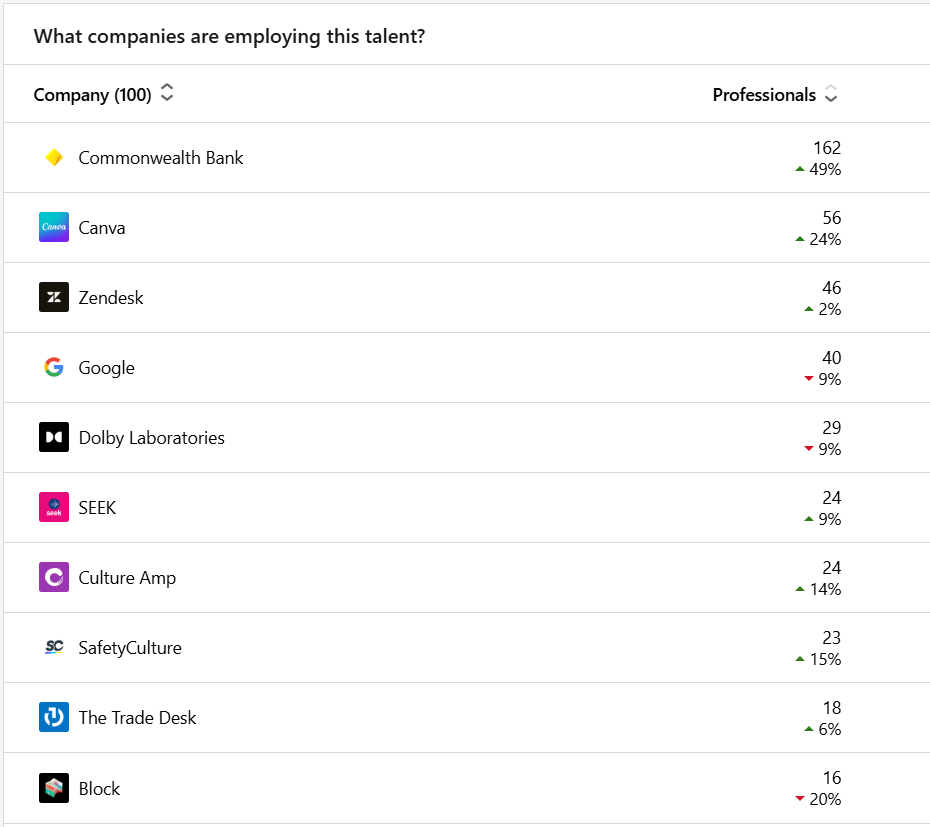
*LinkedIn Talent Insights 2025.

This Newsletter is brought to you by the ScaleUp Recruitment Team, we’re always interested in a chat so feel free to give us a call. If you are looking for a new position send us your resume and we look forward to speaking to you soon.
 |  |

We are always looking to improve the information contained in this newsletter and the best way for us to do that is if you let us know what you are interested in and your thoughts.
We encourage you to send us an email (easiest way is to reply to this newsletter) and let us know. Key areas we are keen to hear about are:
Your thoughts on the newsletter (good or bad).
Principal & Staff Engineering topics you want to hear about.
Thoughts around the information in this newsletter.
Are you looking for a Principal Engineer position?
Are you hiring for Principal Engineers?
